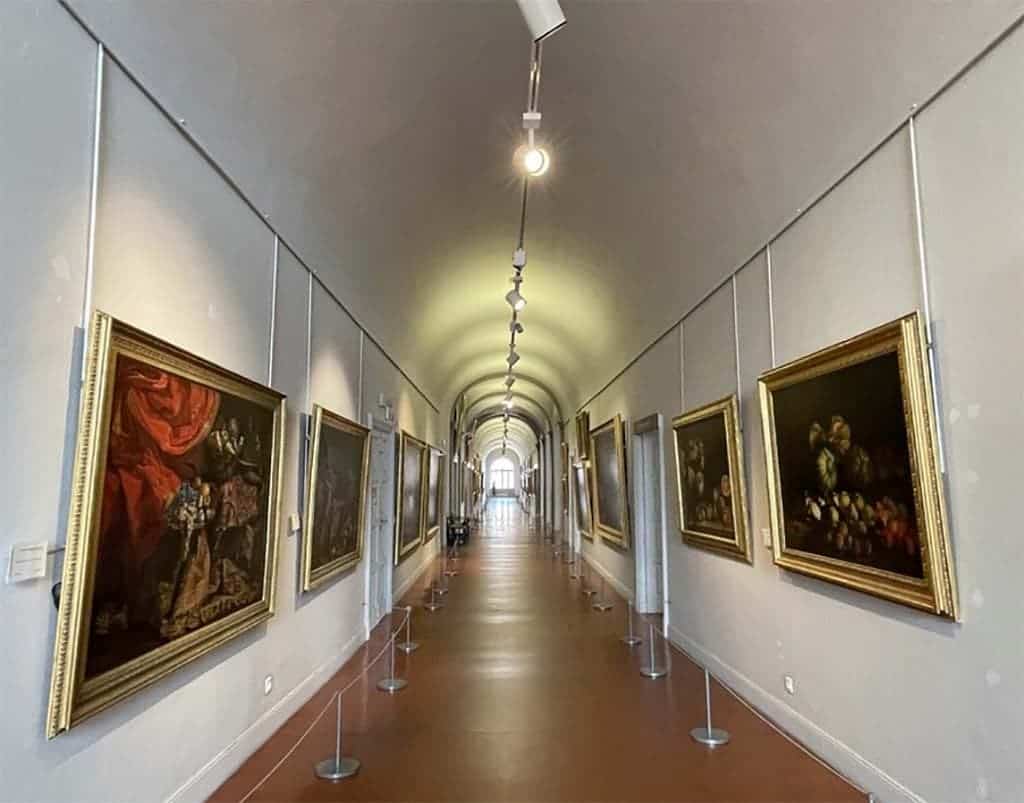
Cardinal Joseph Fesch, uncle of Napoleon’s wife, was bishop of Lyon, and used all his position to acquire many paintings, many of which were spoils of the French forces in Holland, Italy, and Germany. His gifts to the city include paintings by 17th-century French and Spanish masters, but the works of Italian artists – Raphael, Titian, Bellini, Veronese, Botticelli – are most attractive.
A Bit of History
Born in Ajaccio, in 1763, Cardinal Fesch was Bonaparte’s uncle Napoleon, brother of his mother. It was Napoleon who helped him reach such heights in the church hierarchy. And his position allowed him to amass a collection of 3,000 paintings during the Napoleonic Wars. By the way – he bought them (considering. that before he became a priest, he worked in the military department, from where he was dismissed for bribery and extortion). It was he who performed Napoleon’s ecclesiastical marriage to Josephine, on the eve of his coronation (the civil marriage had been consummated earlier). For which he received the title of Count and the title of Senator Grand Chaplain of France. He later received a bunch of other titles and positions, but resented Bonaparte’s disrespectful attitude toward Pope Pius the Ninth, for which his nephew exiled him to Lyon.
After Napoleon’s defeat, he and his sister Laetitia (Napoleon’s mother) fled to Rome, where he spent the rest of his life. When he died, most of the collection was sold and, according to his will, the proceeds went to charity. The most expensive painting by Leonardo da Vinci, St. Jerome, was purchased by Pope Pius IX for 2,500,000 francs.
And the rest of the collection served as the basis for the museum in Ajaccio.
Cardinal Fesh’s collection, bequeathed to the city of Ajaccio, consisted mainly of Italian paintings from the late 14th century to the early 19th century, making the museum collection one of the most important collections of Italian paintings in France.
Portraits and sculptures of members of the Bonaparte family, and of Napoleon himself, have been added to this important collection. The museum also displays liturgical objects, and everyday objects belonging to the cardinal.
These various works of art form the basis of the collection, which has since been enriched by several donations and legacies, such as those of Felix Bacocchi in 1866, the Duke of Treviso in 1892, Jerome Napoleon in 1897, the Rothschild family in 1889 and 1909, Baron and Baroness Vognsgaard in 1974 and 1992, and Francois and Marie-Jeanne Ollandini in 2007 and 2009.
Count Felix Bacocchi was the grandnephew of Prince Felix Bacocchi, the husband of Elisa Bonaparte, Napoleon’s sister. During the Second Empire, he became the First Chamberlain of Napoleon the Third, managing the court shows, and the theaters of the Empire.
He had a wealthy large villa built in the Cannes district of Ajaccio (today’s Lycée Saint-Paul). In 1866 he bequeathed sixty-four paintings to the city of Ajaccio, particularly contemporary works acquired in Paris, some examples of which can be seen here. In honor of its benefactor, the city commissioned a bust of the count from Vital-Dubre, already the author of a monument in honor of Cardinal Fèche (in the courtyard of the palace).
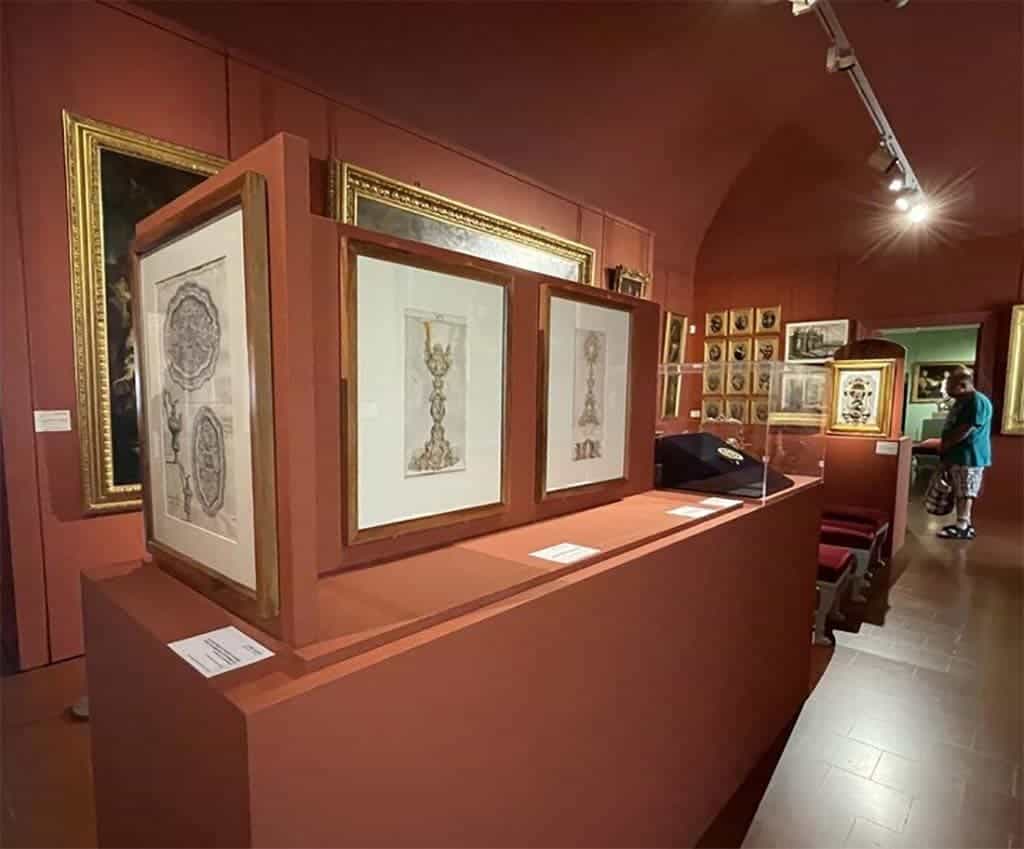
Ground Floor
The ground floor is dedicated to Napoleon, Corsican paintings and the temporary exhibition “Rome of the 18th century”. The Napoleon collection has been built since 1839, thanks to various bequests and donations. It is rich in portraits, mainly from the bequest of Cardinal Fèche, the main ones being paintings by François Gérard.
Corsican painting as a section of the museum was born entirely from public donations, and from works relating to Corsica acquired at the Salons des Beaux-Arts, and through the generosity of many donors. The section offers an extensive overview of island painting, from late 19th-century academism to realism or the pictorial vision of artists of the first half of the 20th century.
The two floors devoted to Italian painting are best visited starting on the second level, with paintings displayed in chronological order. From the golden stock of the 14th century to the Roman painting of the 18th century, the museum is particularly rich in works of Italian 17th century, represented in all aspects (from Caravaggio Realism to the colorful profusion of Baroque) of all genres (from forbidden images to still lifes, including landscapes and portraits), and all Italian schools of the time.
First Floor
The first floor is dedicated to Italian masters of the 16th-18th centuries.
The second floor is occupied by paintings of Italian masters of the 14th-17th centuries.
The oldest paintings are of the Late Middle Ages. Primitives, who worked between 1100 and 1400. Their paintings were done on wooden panels, they did not yet use canvas and did not have tubes of finished paint. They had to work on wood and create their own paints. It’s a long and difficult job. They didn’t paint blue skies, they had a gold background, and that’s real gold.
Very interesting, it seems to me, is Jacopo da Empoli’s (Jacopo Chimenti) Age series, painted in 16th century Florence. The paintings represent stages of life. Childhood, with a little girl playing merrily. Youth, with a girl dressed in a beautiful princess gown. Maturity, the age of mothers, the picture shows a round belly under heavy clothing. Old age, an old woman leaning on a stick.
In the Middle Ages, religion played a very important role in people’s lives. Everyone went to Mass, but almost no one understood the priests’ speeches in Latin. The church commissioned pictures depicting the lives of the saints so people would know the stories of the Bible. It was a kind of “comic strip for the illiterate. And to make the characters recognizable, the artists always dressed them the same way. The Virgin Mary is dressed in blue and red, and if, and look at other paintings, it will be the same almost everywhere.
The Renaissance was a wonderful period for painting. Artists began to take an interest in the human body and depict reality. Compared to the previous painting, in this one Mary is gently holding her baby like a real mother. Jesus here is a real baby to be supported (in the older paintings the baby is standing on his feet, which is not real). Behind them is a real landscape and a beautiful garland of flowers, not just a gold background.

